Sunday, February 27, 2011

Withdrawal

    I am shaking, sweating and a bit nauseated as I write this.  I can not concentrate.  No, we have not been anywhere near the earthquake devastation that has recently happened on the South Island in Christchurch.  Our thoughts and prayers are with the people affected by that tragedy.  Instead my shaking, sweating and nausea comes from the fact that it has been over 10 months since I last wrote a prescription for those desperately sought after pain medications of Vicodin, Lortab, Oxycontin and Dilaudid. 
    What is it with these Kiwis?  Why do they not need massive amounts of pain medication?  In ten months I have seen only one bonafide drug seeker.  What the heck.  I am missing being told I do not know anything about pain.  I miss the threats of being sued for misdiagnosing the chronic abdominal pain that has had three CT scans,  2 ultrasounds, 14 xrays, and multiple non diagnostic specialist consults in the greater Central Oregon hospital service area within the past year.  Definitely signs of craving as I go through withdrawal.
    So imagine my joy when I had a twenty something year old male in the office a few weeks ago complaining of dental pain.  I sat back and enjoyed watching the 5th year medical student from Auckland work his way through the patients history, waiting for my chance to discuss the difficulties of assessing a patients pain level and need for medication.  Especially in the setting of dental pain where some relatively benign exam findings can be very painful and severe dentition can be painless.  As the medical student finished his exam, I shifted to the computer to search Pharmac (subsidized medications from the public health care pharmacy schedule and not to be confused with Big Pharma in the US) to find an appropriate narcotic containing pain medication for this patient who had a very painful looking dental infection with a fractured tooth.  I felt a euphoric rush as the patient stated " Can I get something else for the pain?  I have been taking Panadol (Tylenol) and it has not helped."

    Relief in site?  I will possibly be writing my twentieth narcotic pain medication prescription (the other nineteen were for incarcerated patients on methadone withdrawal programs or hospice patients, no chance for misusing the drug) since I have been in New Zealand.  A minuscule fraction of what would be expected of me in practice in the US.  I am conditioned to know what is coming next by all the similar patient encounters in the US.  I can hear it, almost music to my ears... "Doc, can I get some of that uh Vik..uh Viku..uh...Vikudin stuff?"  Yes, say it.....But wait, this is a Kiwi patient.  "Can I get some of that stronger pain medication called Brufen?"  Aye?  Brufen is ibuprofen.  Mate, that looks painful, are you sure?  Lots of guys in your demographic in the US  claim they are allergic to brufen or it does not work to relieve pain.  "Brufen works really well for me, thanks doc."
    Bugger!  My withdrawal from patients demanding high strength pain medications will continue.  What is it that makes these Kiwi patients have a different perception of pain.  Pain results when our body suffers physiologic damage to tissue which releases inflammatory chemicals and neurotransmitters to stimulate pain fibers in the nervous system.  Our perception of pain is then modulated by the brain and is influenced by many factors including previous experience with pain and socially accepted expressions of pain.  Socially acceptable such as the difference between a Hmong woman delivering her child and placenta without a whiff of noise and a Caucasian diva screaming for an epidural the minute her uterus thinks about having a contraction.   Time to do a little research...
Ouch

    After exhaustive research, (exhausting work goes better with a cup of coffee and newspaper to start the day) I realized I had to look no further than the Monday morning sports page (get your pain right here)!  What makes Kiwis different from Americans in their demand for pain medication?  Look no further than the national sport and pride of New Zealand:  Rugby.  Not by coincidence I started my research on the weekend that coincided with Super Bowl weekend in the US.  What better way to contrast the social understanding of pain than to see how the gladiator heroes of a country respond to their injuries and pain. (Biased research disclaimer:  I tend to prefer sports stories like the 2010 Crook County High girls volleyball team who washed cars, had bake sales, and carpooled to games to overcome school budget cuts to go on and win their fourth straight Oregon state volleyball title as opposed to hearing about how much money Brett Favre will earn to lead the Vikings to another mediocre season).
    Luckily on Super Bowl weekend, the research project came to us. (Any Big Pharma out there want to sponsor my next project?)  Self funded research only provided tickets and transportation for my research assistants and I to the Kerikeri Domain where the final preseason test of the Auckland Blues and the Wellington Hurricanes would take place.
    The Hurricanes and Blues field 14 present or former AllBlack national team members, so bonafide heroes for the nation.  Pain is definitely part of rugby as it basically involves guys the size and fitness of football middle linebackers and free safeties pummeling each other without padding, colliding at high speed, (occasionally getting their heads squeezed between the sweaty bums of two front line players, but I'll save that detail for the scrum) until the ball is advanced over the try line.  It took until the middle of the second half to find the subject for my research, when not one, but two rugby players lay injured on the pitch.

     Observation One:  If you are hurting, the game still goes on.  Both players went down after tackles within an approximate one minute time span, leaving them writhing on the field in pain.  Yet the game did not stop.  Play continued around them, risking further injury to the players, but on the other hand an acceptance of needing a quick resolve to get beyond the pain and get out of the way.   Contrast that with professional football's game stoppage (commercial time) and speculation from the announcers regarding the nature of the injury (dwell on the pain).

Medic One
     Observation Two:  All bleeding stops, eventually.  Not to ignore the risk of the spread of infectious disease through contaminated body fluid exposure, but there is a little less focus on removal of blood stained jerseys and universal precautions during the game than there is in the US (not a lot of rubber gloves on the sidelines).  A good compression dressing around those torn earlobes and you are good to go again, mate.

Water boy/medic two
     Observation Three:  You are long way from complex medical care, so you might have that pain for awhile.  Note the orange medic clad individual on the lower right observing the pitch, and in the second picture the green shirted water boy/medic two.  These two fellows are your primary responders in this test.  This game is taking place with the nearest complex medical care nearly an hour away.  There is a volunteer ambulance crew stationed nearby, but no doctor scheduled for sideline care.  The volunteer ambulance crew has a limited amount of ability to administer pain medication.  Knowing that your national hero could be suffering through a long ambulance ride in pain from a broken leg certainly sets the socially accepted level of complaining about pain a little higher.  Contrast that with in training room xray machines and sideline physicians all the way down to the high school level in the US.  The US wins this one with the ability to provide immediate care for the pain, but it shows how the New Zealand psyche has a different tolerance for pain.
    Both players were able to be assisted off the pitch under their own power.  Applause for their recovery as the game continued.  I contemplated the following headline (click on it to read the fine print)


as I drew up conclusions to my research project.  I am thrilled that the Oregon legislature enacted the Web-based computer monitoring program so that physicians can have ready access to determine if a patient has recently been prescribed narcotic pain medications.  It is not an invasion of privacy for a physician to have access to this data.  It is data that can mean the difference between life and death from a drug overdose for a patient.  For those 18 to 25 year old who show up begging narcotics from their dentist or doctor, instead of being coerced into prescribing to them the conclusion of my research shows that the medical provider should take them outside for a good game of rugby! (Now who in the FDA do I need to buy in order to sell my billion dollar medical solution?)
    Addendum:  Watching New Zealand respond to the crisis in Christchurch has been amazing.  Calls were put out for assistance from all professions including medicine.  Within one day, the Cantebury GP service coordinators had to tell physicians from throughout the country to slow down on sending in the volunteer forms.   They were overwhelmed by the response and had enough volunteers to cover over a month of relief.  Just another way in which New Zealand deals with the pain.  Pick up your mates, and help them move on.
    Kia Kaha = Stay Strong.


Wednesday, February 9, 2011

Down Under is West of New Zealand

      A point of correction which many New Zealanders have offered to us Americans who are generalized into the category of geographically challenged.  As in "We New Zealanders know where America is located, but you Americans sure do not know where New Zealand is located."  So we are living in New Zealand and not "Down Under" aka Australia.
     We did enjoy celebrating the start of 2011 by traveling  "Down Under"  from December 29 - Jan 10.  (Travel Advisor: not a good time to travel in Australia as it is school holiday, prices are increased, hotels are booked, beaches are crowded.)

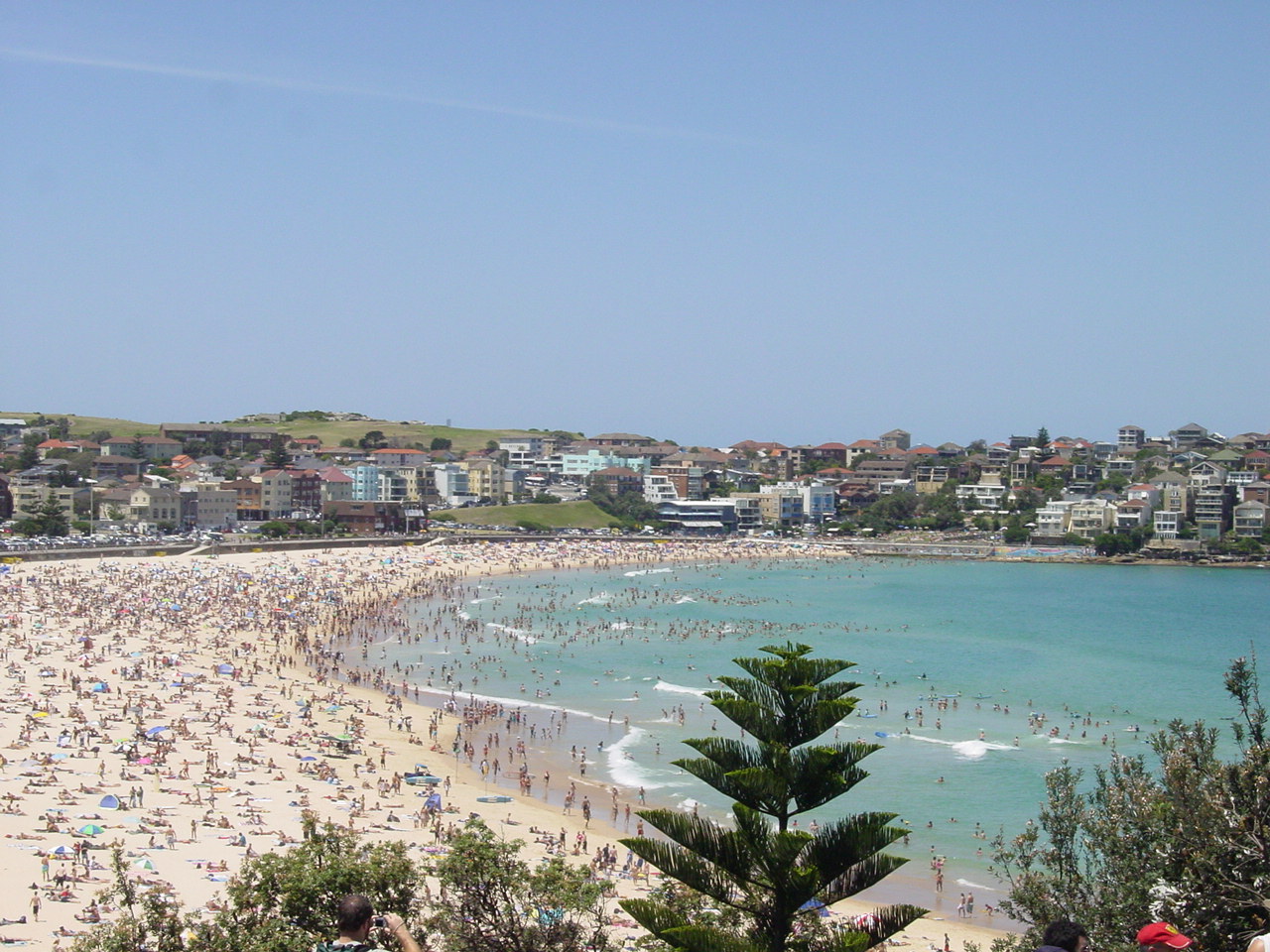
Bondi Beach 30 December!
    The pictures will help tell the story of some of our experiences.
You can click on the pictures to enlarge in a new window.

If you don't want to wait in line to surf, wait in line here for ice cream.
    The Opera House was a highlight of out time in Sydney (Travel Advisor: Highly recommend the guided tour to learn the history of its construction).  Truly an architectural and engineering marvel.
Man made and natural beauty all in one.


The tiles for the arches were templated five at a time.


      We were thrilled to have my parents in good health able to make the trip with us.  (Trip Advisor:  make sure your parents are good sports for travel before stuffing six family members, the luggage for the trip, and a grandson bursting with flatus into an small SUV for a week).  Our family is blessed like the opera house to have good bones to last through the years.
Smiling:  Have not had to be in the SUV yet!


The inside is stunning in its own way.


The Sydney Coat Hanger/Harbor Bridge
     Ten and a half years ago, while watching the Sydney Olympics and pregnant (Kim, not me thank goodness, but I'll take some credit now) for the first time, we chose a name for our child if it was a girl.  Michelie Jones raced along the Opera House footpath to her Olympic silver medal in her homeland.  (Trip advisor:  Way cool to see her namesake run the same path.  Dream for your child and it may come true!).
McKeely chasing Michelie
     We departed Sydney on New Years Eve (Trip Advisor:  Yeah the $625,000 dollar fireworks show that night would have been awesome, but the explosion of a $1200 a night hotel room bill sort of rips a hole in your back pocket).  After a few wayward driving directions from our TomTom GPS (Trip Advisor:  We affectionately dub thee Tombyatch), we made our way not to the Big Apple of fireworks, but the Big Banana of Coffs Harbor. 
For you Minnesotans out there...this is Paul Bunyan's breakfast snack!
    After a not so refreshing nights sleep in Coffs Harbor (Trip Advisor:  At 3 am drunk people sound the same no matter what language or accent they may have.), we made our way to Mooloolaba (Trip Advisor:  say moo LOOL uba).  A good day to drive as we experienced a taste of all the rain that has plagued Queensland Australia this year.  We missed the flooding in Brisbane by only one week.  With the rate and power of the downpours we witnessed, the source of the flooding was simple to understand. 
    Three sunny days on the Sunshine Coast were celebrated with time in the warm waters of the Coral Sea.  Surf lessons were in order, as they were promised to Joel for his birthday.  (Trip Advisor:  9 year old 5'4" surfs way better than hair thinning old 6'7").  Our generalized American obesity epidemic surfaced when the instructor at the end of the class chided me by saying "You're pretty fit, for an American." 
A reminder to swim between the flags.
 

Ready for more.


A little birdie told me.
     We beat the rain for part of the day as we drove back down the Queensland Coast.  We had opted on the advice of our New Zealand friends to skip the more commercial Australian Zoo (Trip Advisor:  Do not tell your kids that you skipped seeing Bindi Irwin) instead choosing to visit the Corrumbin Wildlife Sanctuary.  Excellent advice it was, as the Corrumbin Sanctuary allowed for a more intimate experience with the animals.    
Joel's scalp massage during the lorakeet feeding.


    The children were thrilled to see the animal hospital which takes in the injured or rescued animals from the region to nurse them back to health.  (Trip Advisor:  Surgery on animals that can bite or scratch you while inducing anesthesia is more risky than working in an ER).  We were able to observe as a sea bird received induction of  anesthesia for surgery.  (Trip Advisor:  veterinary assistants would make great ER nurses, as cleaning up bird squirt is just like cleaning up the drunk guy!)


Spoiled Roo!


    We finished out our trip with a stop in Yamba on the northeast coast of New South Wales.  Booking the trip as we traveled added to the adventure as one accommodation was overbooked and subsequently we ended up in the Angourie Rainforest Resort in Yamba.  A beautiful place, if it was not raining most of the time we were visiting (Trip Advisor:  What part of RAIN forest did you not understand?).  Yamba is a quaint little town with some great surf beaches that have yet to be built up like the coast along Surfers Paradise.  Have put Yamba on the list of places to go back to visit someday.


    We completed our travel back to Sydney and returned to New Zealand to our transient/permanent home.  Like any good trip, it was fun while we were there, but also, good to be back home.  First night back in a familiar place and the kids thought dad looked something like this:

   Belated Happy New Year to you!   

Wednesday, January 26, 2011

Planning for Retirement

Give a child a fish, and he will eat for a day.

  
     Teach a child to fish, and she may feed the world.


    Show a child how to fly fish, and maybe when I am old, he will drive me to the nearest river, park me in my wheelchair near my favorite fishing hole, give me a wee dram of scotch and a good cigar, and say have a good day, Dad!


      Retirement plans in sight.  Joel trying out his Christmas present on the school grounds.  Enjoying the last bit of summer/Christmas holiday before the school year begins here next week.

Friday, January 21, 2011

Ninety Mile Beach and Patient Expectations

Cape Reinga Lighthouse
   Since arrival in New Zealand, I have been trying to surmise what is different about providing primary and emergency health care to New Zealand residents as opposed to Americans.  No, the anatomy is not different, or at least I have not found the usual orifices in unusual places in the Southern Hemisphere.  As I go through my daily list of 27 patients, I realize at the end of the day that despite the same medical challenges, something is different about the attitude of the New Zealand patients approach to their medical care. 
      Talking with colleagues in the US before leaving for NZ, I did receive a few trite answers about what might be different in patient care, but I wanted to experience it myself. Now that we have been here into the new year, it is time to put my own answer into writing.  So how does a medical system that spends one-half to two-thirds less per capita, based on gross domestic product statistics compared to the United States, obtain things like lower infant mortality, longer life expectancy, and better access to care? How does a health care system where there are definitely fewer bells and whistles (and fewer grand piano players in the  hospital entry foyer,  oops, there isn't really an entry foyer either) outrank the USA on a number of desirable health outcome statistics?
     The summary I was looking for was found not in the exam rooms of Broadway Health or Bay of Islands Hospital, but in the sage advice of a holiday house owner in Ahipara, the town at the beginning of Ninety Mile Beach.  We, (Kim, the kids, and Karen and Tracy, two of Kim's classmates from physiotherapy school in Holland) had stopped overnight in Ahipara on our triangular tour of Northland from the Hokianga Harbor, to Cape Reinga and back to Kerikeri.  Paul Steele (check out www.holidayhouses.co.nz/properties/1979.asp) the owner of the beach front home at which we stayed, and a retired dentist from Wellington, took me aside as we were preparing to start our drive from Ahipara to the Cape.

Cape Marie Van Diemen
Immediately west of Cape Reinga
      Paul had sized up our situation.  Americans for sure by our accent (he even introduced us to his neighbor, a former resident of Sun Valley, ID.  Idaho is a small state, but didn't know him.).  Middle aged bloke traveling with three beautiful women and two children (bloke's a bit crazy?).

Tracy, Kim and Karen
  Automobile suitable for some Northland locals and a beach run (check out the pictures of our wheels known as  "Beastie Babe" and the trailer "Beastie's Behind").  Seeing that we met all the requirements he was ready to give us his advice for travel.

Beastie Babe and Beastie's Behind at the end of Te Paki Stream and the beginning of Ninety Mile Beach
      "First, I wouldn't recommend what you are planning on doing." (Wait, we had not even discussed what we were planning on doing, other than vague plans for driving the tar sealed road safely up to the Cape and back.)  "I would recommend just going into Kaitia and jumping on one of the bus tours."  (Bus tour, our ignorance.  We did not even investigate a bus tour option).  Then he showed me the answer I had been looking for about the joy in life and blunt approach to their health care that I had appreciated from so many patients.  Paul, with a sudden sparkle in his eye and a devilish grin, unfolded a map in front of me and said, "I would drive up the main road to the Cape, then when you get back to TePaki Stream, put that car in 4 wheel drive and gun it down the center of the stream.  Maybe take a look around the first corner on foot before you go in, but otherwise don't stop driving hard until you get to the beach. If you bog down a bit, just gun it.  I have checked the tides for you and you should be all good.  Otherwise, just don't drive too close to the ocean and too close to the sides of the stream, where you can end up in a soft sand hole.  You will come out alright at Waipapakauri Road."
   Once we made our drive on the tar sealed road all the way to the Cape, with a stop at the Kauri Kingdom(spectacular kauri tree woodwork) and a brief test drive of Beastie on the white sands or Rarawa (Jetson's Astro pronounced that one) Beach we made our way back to Te Paki Stream Road.

Rarawa Beach.  Yes we had most of it to ourselves!
 As Joel and McKeely tried some sand boarding on the dunes above TePaki, I walked around the first corner and had a look to the beach (couldn't see it as there were alot more corners in the stream before Ninety Mile Beach).  Suddenly Paul's words, my experience with patient expectations in two different countries, and the metaphor of an equitable health care system all came together.
    I stood in shallow stream water on solidly packed platform of sand that shifted only slowly and slightly with my steps.  New Zealand people needing medical care, like much of the rest of the sane (not US) industrialized world, start with a secure platform of single party payer (usually government) health care.  Compare that to the current US system which would look more like a boulder strewn river.   Great if you can cling to one of those insurance rocks (did you see that Big Blue Boulder), but the water is deep and fast moving (drown your family in bankruptcy) if you lose your job or are denied insurance.  If you can hold your breath long enough in the US system (lose all your finances first), you may get caught by the bottom level small rocks of Medicaid.  The smooth secure platform of guaranteed health care for all, allows New Zealanders to have far less anxiety as a starting point about what their diagnosis may be when they arrive in need of medical care.

    The kids had finished sand boarding when I returned, so we loaded back into Beastie.  Continuing the metaphor, I would consider Beastie as the health care providers in New Zealand.  Solid, reliable, a few dings, but utilitarian and dependable for everyones need.  In the US, the providers probably win this part of the metaphor, so think of Beastie in the US as a full size Ford F-350 4X4 with all the upgrades to help you crash through the boulder strewn stream.  Just like myself, and many of the other providers in New Zealand, as I discussed in my previous post, Beastie is an import!  In the US though, even the best providers get caught drowning with you beneath the boulders of the bureaucracy of insurance boulders.
     I started Beastie up, put her in 4-wheel drive and off we went.  Like anyone with a medical condition, going around the first corner in the stream is a blind corner, and everyone inside of Beastie had a little anxiety.  In the US, our recent health care reform debate convinced us of all kinds of fears around that first corner in a diagnosis.  A single party payer system will cause us to "lose your choice and independence", or "death squads lurking", or "government cronies will decide the care you receive".  Beastie rolled into the stream with the sand firmly supporting us, and I added a little speed for Beastie to get around the first corner.  Instead of additional dangers, we found exactly what people living with a single party payer health system in New Zealand have found:  wide open pathways to maintaining our health (the stream widened through the sand dunes), independent choices ( the stream split around soft sand islands in the stream, and we could chose either side), and security (we made it safely to the wide driving path on Ninety Mile Beach!).
     That is what I have found with patient expectations here in New Zealand.  People have independence with confidence that the system will provide for them when in need.  They understand that if their diagnosis warrants it, they will receive the care they need immediately, and wait with appropriate patience if their diagnosis is less critical or life altering.  They understand their choice that they can buy up to additional private insurance which gives them access to faster, but not better medical care.  They come in with the security that whatever the diagnosis, their family will not be devastated by an additional financial ruin.  They know that if something with their care goes wrong they will have financial support (ACC and WINZ programs). They often question me how our country can have a system that seems so unfair from their point of view.  Peaks and valleys they refer to it.  Hence  the boulders in the stream analogy.
    Our traveling group proved that such a system of single party payer health care could work from coast to coast in the US.  One-quarter the way down the actual 55 miles of driving Ninety Mile Beach, Karen, who is from Long Island in New York City took over Beasties wheel.  She safely guided Beastie the rest of the way to the Lake Ngatu turnoff to return to the tar sealed road.  From Oregon to New York state we enjoyed the drive on the solid sand beneath us.
      As we made our way back to the main road, we all had a sparkle in our eye and a grin on our face, much like Paul's.  Thrilled by the beautiful scenery along Ninety Mile Beach and joy in overcoming a fear unknown.  Maybe we should approach our solution to the health care problem in much the same way.  Overcome our fears of a single party payer health care system.  Wouldn't it be nice to not fear financial devastation anytime you need medical care?  Come on, jump on board Beastie, and we will go for a ride! 

Wednesday, December 29, 2010

Why Am I Here?

    While on a recent site seeing trip with visiting family, I had some extra time to contemplate life.  The boat slowly motored out to Hole in the Rock/Motukokako Island at the end of Cape Brett on the southern boundary of the Bay of Islands, leaving plenty of time for introspection.  Maybe it was the somber cloudy day.  Maybe it was the proximity of another passing year in my own life.  Possibly it was the seasoned words of the lovely 92 year old lady, my patient on the previous day, whose sharp Irish/Kiwi wit polished by a childhood French finishing school, that had left me contemplative.  "Multus Annos Domini" was her own self diagnosis, as her sharp mind remained well ahead of the failings of her body.  The years passing by, purpose still present, but body unable.  Most likely it was my wife, who reminded me as we got out of bed this morning, that by life expectancy, "Your life may be more than half done!"  (Thanks for the birthday wishes, honey).

     Life itself is a purpose for being here on this earth.  Each day lived is a chance to feel, breath, experience, share, love, and cherish life itself.  For some, end of life comes too soon, for others it comes too slowly, but the reality is that none of us get out of this life alive.  Purpose is simply found by living each one of our days to its fullest.

   If you would have asked me 20 years ago when I was a freshmen U of Minnesota medical student if I was planning on practicing medicine in a foreign country for an extended period of time, my answer would have been no.  Mostly because I would not have considered "God's Country" of Montana a foreign place, but instead my home state that I still miss.  Once again the joy of life and living with purpose that can lead us directions beyond our wildest dreams.

     So with kind regards to Nietzsche and Kierkegaard, instead of asking, "Why am I here?", I will change the question to "Where have all the Kiwi doctors gone?"    Recent media attention in New Zealand, both written and televised, have drawn attention to the ongoing crisis in New Zealand's health care system.  The emigration of New Zealand trained doctors has resulted in a shortage of available physicians to provide necessary medical services throughout the country.  With a country this beautiful, why would anyone want to leave?  Everything is so green....
    Not green enough according to statistics from the NZ Resident Doctor's Association.  The salary disparity for house officer (intern) and registrar (resident or fellowship) level physicians between New Zealand and Australia is one of the first reasons listed for the migration of NZ medical students.  Even with factoring in the recently strengthened NZ dollar, the disparity ranges per year from $7,000 AUS$ ($6,900 US$, thank goodness for our weak economy, as my NZ$ goes further) for first year medical trainees, to as much as $32,000 AUS$ per year for fellowship trainees.  That money easily buys a few plane tickets over the Tasman for visits with the family.  
   Once those physicians leave, it is less likely they will return.  Money potentially being a motivator again, as salary disparity between Australia and NZ consultant level physicians indicate a range of 7% to 30% difference of income depending on specialty.  Data from the Auckland graduating class of 1999 indicates that 46% of the class permanently practices outside of New Zealand, with the majority of them having ceased their registration (license to practice) in NZ.  Similar to the US, physicians in training are more likely to settle in the region in which they have trained.  A losing situation for New Zealand.

    That is where a physician such as myself fits in.  Nearly 41% of physicians practicing in New Zealand are international medical graduates (Damn foreign doctor has an accent and I can't understand him!), compared to 21-25% in the US.  The system does not suffer though, and in some cases benefits.  The majority of foreign trained physicians who choose to permanently relocate to practice in New Zealand tend to be from other Commonwealth nations (UK, India) or Asia.  US trained physicians tend to only stay for a short period of time.  A statement more about our tax structure in the US than the quality of medical care that is provided in New Zealand.  Uncle Sam gets a piece of US citizens wherever we live, whereas citizens from other countries who relocate to New Zealand, are only expected to pay taxes in New Zealand. 
     Despite the challenge of double taxation, and potentially a lesser income, I found another reason for our prolonged stay here in New Zealand.  Interestingly the letter quoted below was handed to me on my first day of orientation with NZ Locums. It is written for new enrollees in the Medical Protection Society (malpractice insurance) when they start practice in New Zealand.  
    
    "Most days, most people will make a mistake, normally small and inconsequential ones that are never discovered or result in no harm, although occasionally they will be serious or embarrassing.  The point is that everyone makes mistakes but most people are fortunate enough not to be a doctor who can be formally investigated two, three, possibly four or even five times over, concerning the same incident.  It is a fact that adverse events will happen.  Everything should be done to try to minimise those avoidable errors but there must be an acceptance that some will occur - it is how we react to these events that is vital.
     My fear is that if doctors continue to believe that they are under sustained attack and fear the stress of prolonged investigation for one or two mistakes in a career, then many of those who are the most caring and conscientious will decide to leave the profession early or, even worse, decide not to train in medicine in the first place.  Can you imagine the uproar if members of other professions could expect to be investigated at some stage in their career?
     The move towards the harder-nosed, thick skinned, more money-oriented doctor has already happened in the USA and has perhaps started elsewhere.  If it gathers pace, then it will be to the detriment of society as a whole."

    Matthew O'Brien, General Manager Asia Pacific
    Medical Protection Society of New Zealand. 

   The erosion of the hole in the rock at Motokukako Island started thousands of years ago.  It started with a few cracks, enlarged to crevices by wind and wave, and eventually resulted in the hole in the rock institution that stabilizes the island.  The practice of medicine and health care in the US is our island for safety.  With the recent passage of major health care legislation that contained no meaningful malpractice reform, the cracks in the US health care system have gone far beyond crevices and become holes in an institution that is necessary to support a successful nation. 
    I am practicing in a country where more and more US physicians are coming to work permanently.  The ER group at Whangarei hospital is nearly all Americans.  Up and down Northland, many of the GP practices have one or two full time American trained physicians.  One excellent young US physician with whom I oriented in Wellington has opted to stay for a full two years.  Two former US colleagues are on their way here to work for an extended period of time.  Makes me wonder when people in the US will need to look through the hole in the rock, and contemplate "Where have all of our American doctors gone?"

Wednesday, November 24, 2010

Happy Thanksgiving from NZ!

   Normally it would be a morning stumble out of bed to stuff the turkey so that it could be put in the oven and ready for us to dive into a large turkey dinner later in the day.   This year it was a Thanksgiving Thursday stumble out of bed for a 5am departure with friends for a fish and dive in the Bay.  Strapping on dive gear on a balmy day is a far cry from watching leaves (or snow) fall outside while we digest our meals and watch football inside.  But a new kind of abundance was found today.  Kingfish, scallops and crays (lobster).  Plenty of things for which to be thankful this year and every year.
    We wish you all a Happy Thanksgiving!
     

Thursday, November 11, 2010

Mullet is Gone. Replaced by a Whale.

   He missed the dinner and camping overnight on his school outing, but I don't think it bothered him.  The smile on his face tells the tale.  Outfished his dad and a near record for the boat.  Schnappa season is on in the Bay.  This is only the second snapper he has caught since being here in NZ.  Right in our new backyard.
21lb Snapper